Friday, 9 September 2011

WORMWOOD by Catherine Czerkawska (Part One)


Catherine Czerkawska
When the Chernobyl nuclear disaster occurred in April 1986, I was three months pregnant, with my son, Charles. The feeling of helplessness as the radioactive cloud drifted towards Scotland has remained with me over the years, as it has with friends who were in a similar situation. I’m not sure whether this was compounded or relieved by the fact that my much loved father, a distinguished research scientist, was working at (but just about to retire from) a facility where the radiological protection officer was running environmental tests in this part of Scotland. He reported that, even here, so far away from the accident, there were minor hotspots. That – for instance – places where rainwater collected, dried a little, collected again, would contain concentrations of radioactivity. Friends with sheep farms also reported that contamination seemed to be patchy and not terribly predictable. I, meanwhile, was confined to the house with flu. It was no picnic being pregnant and having flu, but – as it turned out – it was a blessing of sorts. 

As a playwright, I knew that I wanted to write about Chernobyl, but it was many years before reliable accounts would come out of the Ukraine. The rise of the internet helped. My father helped. And I always knew that, whatever it was going to be, it wouldn’t be a simple anti-nuclear polemic. My father had worked for the International Atomic Energy Commission in Vienna, and was by no means anti-nuclear himself. But he was still sceptical about, for example, costs of decommissioning and was fond of going to promotions held by the nuclear industry and asking awkward questions from a position of knowledge. 

The play was called Wormwood, and not just after the now notorious biblical quotation – ‘And the third angel sounded, And there fell a great star from heaven, Burning as it were a lamp, And it fell upon a third part of the rivers, And upon the fountains of water. And the name of the star is called Wormwood. And the third part of the waters became Wormwood And many men died of the waters, Because they were made bitter.’ But it’s still chilling, even now, to think that Chernobyl means wormwood, so named because the bitter plant grows in profusion in that area. 

It was inevitably going to be an ‘issue based’ play, but that didn’t mean that it was only going to be a play about issues. Drama of this sort can be deadly dull, tub thumping of the worst sort. For a long time I wasn’t sure what form the writing would take. But I began to read extensively about the subject and the more I read, the more troubled I became.

A scene from WORMWOOD
The play – or my writing of it – began in the mid 1990s, with a hesitant  voice trying to describe the events of that warm April night in the Ukraine – a nice spring night when people would have had their windows open. The voice was speaking in terms that would not only be comprehensible to the lay person, myself included, but which would convey some of the horror, and the sense of inevitability which seemed to lie at the heart of it. With that voice came a clear vision of an abandoned place, a place where time and normality had stood still, a place where human lives had been destroyed and many potential futures ruined. (Later, when I saw the pictures, I was amazed by how accurate my visions had been.) As I found out more about those real human lives, the idea of the play began to take shape. I didn’t want it to be a play about some remote disaster that ‘couldn’t happen here.’ Because the more I explored and read, the more convinced I became that, given a particular set of demands upon human fallibility and complacency, anything can happen anywhere. 

Somewhere along the way, I discovered a quote from Albert Einstein, who wrote ‘The splitting of the atom has changed everything except our way of thinking and thus we drift towards unparalleled catastrophe.’ Wormwood, the play, is about the effects of one such catastrophe on a small group of people most closely involved: two scientists working at the reactor, a fireman, his schoolteacher wife and their young son. There is also a mysterious character who interrogates the others, who interrogates the situation itself, in an effort to make some sense of it. 

The play explores all kinds of things, but especially the fact that a safety experiment triggered the disaster. Chernobyl has always, I think, been played down in the West with the belief that because we have better technology it ‘could never happen here.’ And there’s a good deal of truth in that supposition – but all the same, when human beings are dealing with dangerous technologies ‘you decide that some things are so very unlikely to happen, that they can safely be ignored. First you persuade yourself of this unlikeliness. Then you set about persuading other people. You have covered all eventualities, the unthinkable can’t possibly happen and so you realise that it would be a waste of time and resources to plan for it happening. But if it should happen, not only will you not know what to do. You will not even know what to think. And if it should even begin to happen, neither you nor your colleagues will notice until it is much too late to do anything about it.’

Earlier this year, as I watched, transfixed by those successively exploding reactor buildings in Japan, accompanied by the voice of a scientist reassuring us that this was actually meant to happen, that all would be well, that no, there was no possibility of any kind of melt down, I remembered those lines from my own play, with a certain wry amusement. But it wasn’t amusing at all. And neither is our media’s reluctance to engage with Fukushima and what happened there, beyond those first alarming weeks. Reuters reports today (25th August) that ‘nearly six months after the world's worst nuclear crisis in 25 years at the Fukushima nuclear plant, Japan faces the task of cleaning up a sprawling area of radioactivity that could cost tens of billions of dollars, and thousands may not be able to return home for years, if ever.’ But you have to hunt online to find the report. The BBC doesn’t seem to consider it worth a mention. 

[Part Two of this guest blog will be posted tomorrow.] 

Biographical Note: Catherine Czerkawska is an award winning author of historical novels, short stories, many plays for the stage and more than 100 hours of drama for BBC Radio 4. When not writing, she also finds time to collect and deal in antique and vintage textiles, especially those with a Scottish or Irish provenance and often finds herself writing about them. She blogs about her work at WordArts

Her latest literary venture is to publish her out-of-print novel The Curiosity Cabinet as an eBook, on Amazon’s Kindle, along with a trio of short stories called A Quiet Afternoon in the Museum of Torture). There are a couple of new novels waiting in the wings, The Amber Heart and The Summer Visitor, with a new book called The Physic Garden almost completed. 

Wednesday, 7 September 2011

Life and Learning Part 2: Outside Box Town

by Emma-Kate Prout

Emma-Kate Prout will soon begin her final year as an undergraduate in Earth Science and Geography at Durham University. She is delighted to be back to blog during a hectic yet happy summer spent making music, studying the science of seaweed and cereal, and appreciating the art of annoying alliteration.

In my previous post (Part 1: Poetry, Pebbles and Poo), I began with biscuits and ended with an epiphany. Clearly they were good biscuits. I admit that the Why was never quite extinct on Planet Prout, but the science species was critically endangered for a while….


Imagine trying to drive a car as a child. Forget the legal and safety aspects; it’s an analogy (just don’t try telling that to the police). At first you push buttons and pull levers, wanting to know everything about how everything works and why, why it works and how and so on. Then after a few years you become a bit blasé about the whole car thing and just tootle along to work, humming to yourself. You concentrate on the road ahead, keeping an eye on other drivers and admiring the landscape. You start to take for granted the vehicle and its workings, and the millions of complex things happening in the world outside. Then, eventually, you turn a corner and pull in for a quick stop. You open the dashboard compartment where you stash snacks and old ideas. As you grab some biscuits, you spot a Rubix cube you haven’t worked on in ages, and pick that up too. You climb out of the car and suddenly start to think more critically again. You contemplate how the engine works, and what fuels it; someone else has been filling it up for you for all these years and it could be run off Digestives for all you know. You wonder how efficient it is, what the emissions are. Then you remember, after all the summers you spent sweltering in your seat with no air con, that the windows open; they’d just jammed shut with the frost a few winters ago. You hop back in, noticing that you’ve absent-mindedly solved the Rubix cube as you ate your biscuits, and making a mental note to cut down on the metaphors. The weather’s glorious on the next leg of your journey. As you make your way to your new home outside Box Town, your brain breathes a breath of fresh air.


Rather than solidifying the magic and mystery of one’s surroundings and self into a slab of logic, science seeps through even the most seemingly mundane of objects and actions, imbuing them with small, sparkling drops of awe, and leaving the world dripping with the stuff. I am guilty, as are many fellow students, of occasionally forgetting the awe as it’s bottled up and crammed into the corner of a room full of deadlines. But before too long, the fizz blasts the cork from the bottle and I go through a sort of science re-epiphany.


On the desk in my new flat sits a small tray filled with sea-smoothed gems of nostalgia: a selection of the finest pebbles and shells, unearthed from the debris of a decade or so in the back of a wardrobe. I sit at my desk, engrossed in writing for work and leisure alike, with the windows open.


In the coming autumn - what feels like the blink of an eye since I picked up my first pebble - I will begin my third and final year as an undergraduate. Somewhere along the way, I seem to have become a ‘scientist’.

Tuesday, 30 August 2011

Life and Learning, Part 1: Poetry, Pebbles and Poo

by Emma-Kate Prout

Emma-Kate Prout will soon begin her final year as an undergraduate in Earth Science and Geography at Durham University. When she asked if she could write and create some illustrations for the blog she insisted she could do it sensibly if she really tried. Her offer to contribute was welcomed with open arms. No bribes with biscuits were involved.

I was initially unsure where to begin with the blog. My brain was buzzing with half-formed ideas but I didn’t want to simply regurgitate what I’d read about science communication, or copy too closely the good stuff already posted on this page. So I mooched for a while, scribbling any passing words, phrases or thoughts of food on the walls inside my mind. Then I had some biscuits.


After a while longer of me thinking too hard, a thought nudged me in the side of the head: I realised that when I write, or indeed do many other things, I’m half-aware of all sorts of scientific processes- both physical and mental- in operation. And not only do I write about science, and read others’ writing about science, but the whole process of writing, from head (and heart?) to pen and paper, seems to be as much a science as an art- or at least the outcome of a whole splurge of scientific activity. Once you make the links, isn’t everything inseparable from some aspect or another of science, whether or not we understand it yet? It occurred to me that even a few years ago, I didn’t generally think so ‘scientifically’ whilst engaged in writing or anything else except Science as a School Subject. Writing was writing. Science was science. And I decided that ‘proper’ science writing wasn’t proper writing; yes, it was necessary, but a necessary, white-coated vacuum for lyricism and wit. Something changed at some point since then. I decided that the enlightenment I seemed to have undergone was something to celebrate and so began some more blog-shaped ramblings…

Consciousness of science in everyday life, even just of its presence and importance if not its details, opens the mind to a whole new way of thinking (to be blogged about later). The ‘Whys’ are a quality (not a disease) in young children, even if they don’t see them as ‘science’, but are unfortunately often lost later. My early childhood was a whirl of curiosity. There was no specialisation, no segregation of subjects: it was just life and learning. A lot of time was spent in nature, with a semi-permanent coating of water, sand and/or mud, and an innate scruffiness that seems to have survived the years since. Most of the rest of the time, I was attached to a pen, paintbrush, book or musical instrument, and swapped the dirtiness for more refined paint, glue and glitter.

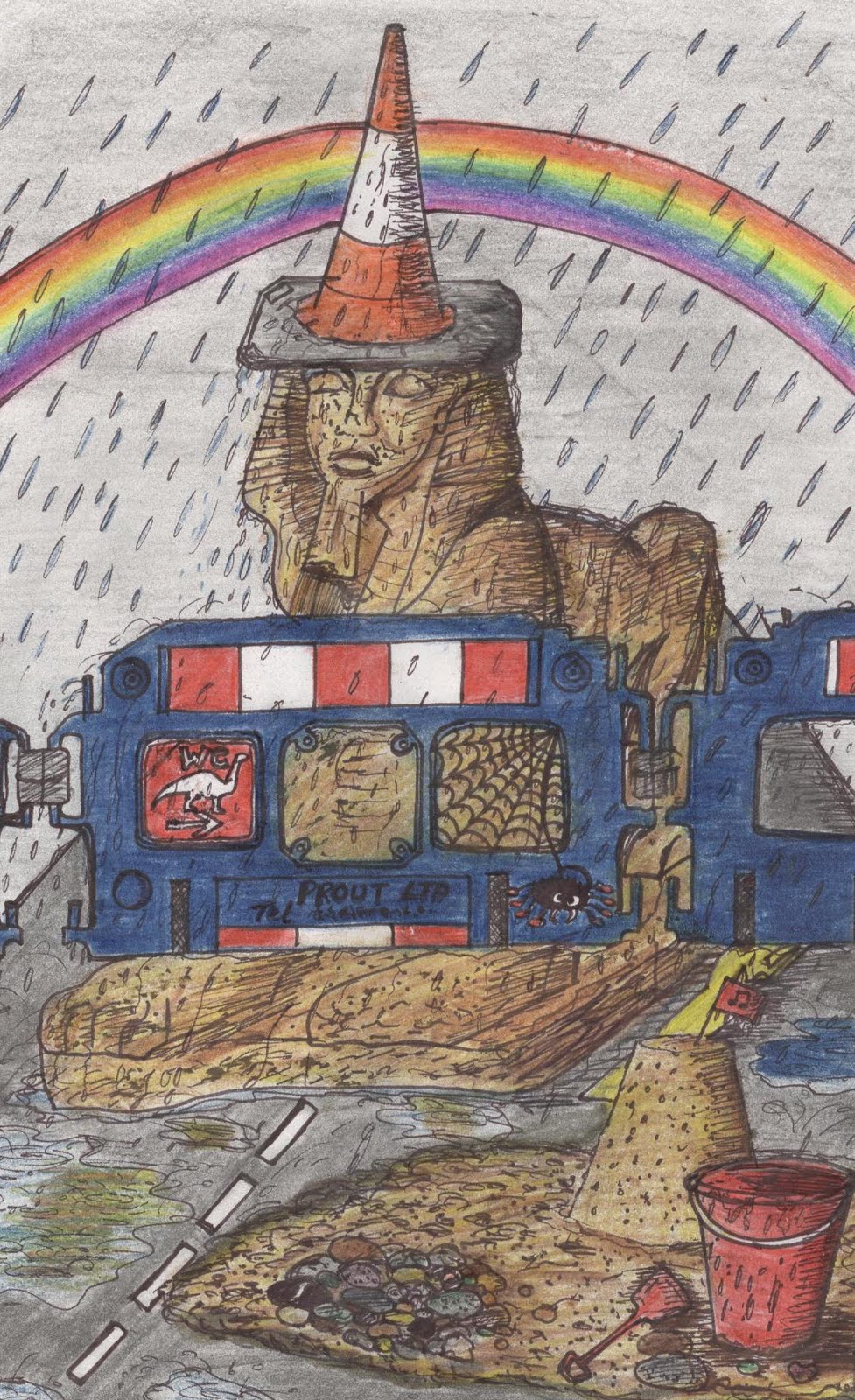
Collecting pebbles was always an addiction. I loved the ink-splashes of colour when I wet them, the stripy, sparkly or speckled ones and the small, round ones that looked like toffee. No sooner was one stone stuffed into a fast-wearing-out pocket than another appeared in a tantalising new shade or an even-more perfect heart shape than before. I was also the proud owner of a delightful, orange-flecked lump of alleged dinosaur poo (‘Jurassic Krap’, I announced to anyone and everyone: ‘Don’t blame me; it’s printed on the poo’). I travelled my world in all weathers, in my own mobile library: my coat carried the legends of Earth in a myriad of minerals. The stones are still scattered among vast collections of childhood paintings, poetry, sketches and stories- volumes on a world with everything from road works to rainbows and spiders to sphinxes.

Gradually, I developed more of a mental distinction between subjects. I don’t remember ever actively disliking science, despite what I said at the time. I went through school quietly, an eco-geek interested in most things except computers, cosmetics and conformity, yet seemingly lacking my now-unconcealed scienciness. Until relatively recently, science was simply ok. I studied it and worked hard, but I certainly wasn’t a ‘scientist’ and never would be, so I said. I think it was a mentality maintained by habit and fear rather than lack of interest. Science had become, in my mind, synonymous with ‘not creative’ and had to be put into mental solitary confinement so as not to eat away at the bigger, juicier right side of my brain: I didn’t want to lose my way with words or skills with a sketchbook among too much logic and lab work.

For a while, then, I didn’t see the planet that I’d hitched a ride on as a spinning ball of science. But something clicked since then. It wasn’t in a single moment; more a series of Rubix cube clicks that led to logic making chaos less…chaotic, yet no less colourful. Constantly, though, the little science-squares mix and multiply with more discoveries. There will always be grey blocks of the unknown: just as we scribble in one with a new theory, we notice another shaded in. In Life and Learning, Part 2: Outside Box Town I will share with you a small journey of scientific revelation...

Tuesday, 23 August 2011

Adventures in Time and Space

(Lynne Hardy)

On Saturday 23rd November, 1963 at around 5.15pm, a new television series aired for the very first time. Its remit was to entertain and educate Britain’s children. It was to become the longest running and most successful science fiction television series of all time: Doctor Who.


One of the Doctor’s first assistants was Ian Chesterton, a science teacher. Intrigued by the advanced scientific knowledge displayed by one of his pupils, a strange girl called Susan, Ian and his colleague Barbara (a history teacher) follow the girl to a junkyard. They wander into a blue police box in their search for her, only to be whisked away on a series of adventures by Susan’s grandfather, the Doctor (played by William Hartnell). Throughout their travels, Ian uses his scientific knowledge to solve many of the problems they encounter. In fact, due to William Hartnell’s age, Ian is very much the heroic man of action on the show, which doesn’t happen very often on TV until the advent of the glossy police procedural scientists in the 00s.

Not all scientists are portrayed in such a favourable light, though, even by fellow scientists! In the later 60s one producer, Innes Lloyd, wanted to introduce more hard science to the stories and brought Dr Christopher (Kit) Pedler on board as an unofficial scientific advisor. An expert in ophthalmology and electron microscopy, Dr Pedler went on to become a writer for the series, co-creating the Cybermen with Gerry Davis. These emotionless, cybernetically enhanced beings from the planet Mondas made their first appearance on our screens in October 1966. They re-appeared, with a slightly different origin story, during the Tenth Doctor (David Tennant’s) tenure in 2006.

The Doctor’s greatest arch-nemeses are the Daleks, created by writer Terry Nation and designer Raymond Cusick, who first appear in the Doctor’s second ever adventure. Although their origin story has also undergone many different iterations over the course of the series’ history (that’s time travel for you), their creator Davros is probably the ultimate mad, bad and dangerous to know scientist on the show. He was first introduced in 1975 during the Fourth Doctor (Tom Baker) story “Genesis of the Daleks”, where his ruthless experimentation leads to the creation of the brutal Dalek race. Like the Cybermen before him, he was reintroduced to the new series in 2008.

No one could really argue the effect that Doctor Who has had on the imaginations of generations of children; you just have to look at the popularity of the new series and the numerous Blue Peter competitions over the years for evidence of that. In his article, Mike Wiggett talks about children not having their curiosity engaged in science classes. However dodgy the science might be, the Doctor is always curious and always trying to use that science (and his imagination) to solve his dilemmas. He sees beauty in everything, like Feynman’s artist, but also understands fundamentally how things work, so marvels even more. That’s a powerful role-model for science if ever there was one.


Between 1973 and 1991, Target books published a series of Doctor Who novelisations. These books were cheap, allowed children access to the back catalogue of the Doctor’s travels in the days before video recorders and endless repeat showings and included those stories that the BBC (in their infinite wisdom) had wiped from their archives. Nev Fountain, co-writer of Dead Ringers, was accused by one of his schoolteachers of reading “too much Doctor Who” as a child. He found the books exciting, but more importantly, he found them accessible, leading to a love of reading in general. In Nev’s case, it also inspired his love of telling stories. And he’s not the only one; many of the writers involved with the show’s revival were inspired as children by the Doctor’s adventures, people such as Russell T Davies, Steven Moffat, Mark Gatiss and Robert Shearman (an award winning playwright and short-story author who trained under Alan Ayckbourn).

At a school in Teeside, one teacher often uses the Doctor to introduce historical topics, thereby taking the character all the way back to his very roots. This gives the children someone familiar to identify with and an excuse as to why someone in costume claiming to be from a different time period can show up in their classroom (the Doctor brought them). A friend is using his collection of Target books to help improve his son’s reading. His son is a big fan of the current show, so his interest was already piqued. They sit together and read a chapter, then watch the old television episode it’s based on and discuss the differences.


So if the Doctor can be used to inspire reading, writing and an interest in history, why aren’t we using him more to inspire budding scientists? Yes, the science in the show can be a bit far-fetched - this is science fiction after all – but so what? It’s the sense of wonder and enthusiasm, the sense of exploration and discovery, the joy of solving a problem based on what you’ve observed that we should be exploiting. Because, let’s face it, everything is more exciting when the Doctor comes to town…

Tuesday, 16 August 2011

CINDERELLA SCIENCE - Part 2

By Mike Wiggett


On 7 August I wrote about the gulf between the prodigious achievements of science and often negative public attitudes towards it.  Modern prosperity owes everything to science, but we don’t celebrate it: we don’t instil in our children an enthusiasm for the wonder of scientific inquiry or an understanding of the Scientific Method.  

Science still wanders at the margins of popular culture. WW2 sowed the seeds of this alienation.  War is always a major spur to scientific research and development. It leads to great technological advances – computers, rocketry, jet engines – and also, regrettably, to nuclear and biological weapons.  And in wartime, research is conducted in conditions of utmost secrecy. 

Thus the main elements of public perception of science in this era were twofold: fear (of its colossal power) and mystery. In the war movies of the 50s and 60s, the heroes were soldiers and fighter pilots; scientists were mere “boffins”, “back-room boys”, and “men in white coats”.  In science, geekdom reigned, and the less the public knew about it, the better.
 
Not much has changed.  Ordinary people remain alienated from science, no matter how familiar and cherished its products. How many of us can diagnose the faults of a car engine, are confident of not getting ripped off by the repair man? Who can understand the electronic circuit boards of a computer, or even change a light fitting?


People not only see science as difficult and daunting, they often take pride in their scientific incompetence. An arts graduate might feel embarrassed to expose ignorance of T S Eliot’s poetry in a pub quiz, but that same person will proudly aver utter hopelessness at maths. The implication is that science is only for nerds, and may be safely discounted. How desperately stupid and wrong! 

Of course, most occupations require no familiarity at all with interferometric microscopy or the Higgs boson, but a basic science education offers everybody one of life’s most precious tools: the habit of evidence-based thinking, an earnest desire to see reality as it is, not merely how one would like it to be. Absence of evidence-based thought in human affairs is seriously corrosive.
  
An example: consider the former doctor (“former” as in “struck off”) Andrew Wakefield. In 1998 he gained wide publicity with an article in The Lancet claiming to have established a causal link between the MMR vaccine and autism in children. However, studies failed to corroborate Wakefield’s “evidence”, which later turned out to be fraudulent. Still the damage was already done: vaccination rates fell sharply, and a number of children have suffered harm or even death in consequence. 

A vivid memory from this period is the BBC News headline on the General Medical Council’s conclusions: “Doctors find the vaccine safe, but we talk to a mother who disagrees.” Appalling!  One can sympathize with a mother who thinks, “My son had the vaccine, my son is autistic, ergo...” but the BBC, as a responsible public broadcaster, should know that the plural of anecdote is not data.
  
Rejection of science in favour of mere whim is commonplace.  Prince Charles has championed the cause of homeopathy, a quack “alternative” medicine proven in countless clinical trials over 175 years to be utterly ineffectual.  But some people still swear by it.  Fine, swear away!  Only don’t lie about the curative benefits of homeopathic nostrums. The closure of the Royal Homeopathic Hospital in September 2010 was a triumph for reason and the NHS budget.


A hilarious aspect of homeopathy is that, even by its own lights, it cannot work! The pseudo-scientific methodology set in place by its founder, Samuel Hahnemann, ordained that the supposedly active ingredient of a homeopathic remedy be repeatedly diluted – to the point where it is completely absent!  

In the 1990s, homeopaths tried to counter this objection with the time-honoured ploy of the snake oil merchant: make it up as you go along. They enthusiastically embraced a Pythonesque notion from the French chemist, Jacques Benveniste; water memory. OK, there may not be any active ingredient, but the water in the homeopathic solution “remembers” it! OK? Benveniste even claimed laboratory evidence for his hypothesis, but nobody else could reproduce his results. Besides, if water can remember the “cure”, why doesn’t it also remember all the sewage it has ever been part of?

Uri Geller with bent spoon
In the 1970s, a young Israeli illusionist, Uri Geller, achieved worldwide fame with his spoon-bending antics on TV.  The mood of that era was credulous and almost everyone lapped it up.  The difference between Geller and a regular stage magician was that Geller attributed his skill to “psychic” powers. They lapped that up too!
  
But Geller was called out by the great illusionist and skeptic, James Randi, who said; “Hey, I can do all that stuff too, and it’s just trickery.” Geller repeatedly tried to sue Randi to shut him up, without success. Randi has since offered a $1 million dollar prize to anyone who can demonstrate paranormal powers. The offer has stood for over 20 years, with no takers. 

James Randi
It is perplexing that so many people are distrustful of science, and yet those same people readily believe all kinds of monkeyshines for which there is no supporting evidence whatsoever! Homeopathy, faith healing, crystal therapy, astrological prediction, palm reading, paranormal and “psychic” phenomena, communication with the dead, reincarnation, Roswell aliens, the Loch Ness Monster...the list goes on and on.

The Loch Ness Monster?...

I have not forgotten our invisible friend in the sky, but religion will keep for another day! Let me close by warmly recommending the animated movie version of Tim Minchin’s beat poem, Storm, much in tune with the theme of this blog and available on YouTube. 


Mike Wiggett retired in 2005 from the mundane business of international trade credit. The foreign business travel was OK, but he now enjoys travelling for pleasure, reading, scribbling and Thinking About What To Do Next.

Sunday, 7 August 2011

CINDERELLA SCIENCE - Part 1

by Mike Wiggett


Mike Wiggett retired in 2005 from the mundane business of international trade credit. The foreign business travel was OK, but he now enjoys travelling for pleasure, reading, scribbling and Thinking About What To Do Next.

Once on a trip to St Petersburg I found myself suddenly alone in the study of Peter the Great.  For a few brief, dizzy moments, I saw the room as he saw it, and wondered how I would have liked being Tsar of All the Russias. The modest refinement of Peter’s study, with its morocco-bound books, orrery and other astronomical instruments, was enviable. And perhaps it would have been fun to come home from Versailles and say, “Make me one of those”, and see it done. On the other hand... 

Even the most powerful 17th Century autocrat was in many ways less privileged than ordinary people today.  I’m much more travelled than Peter was, and he never googled, watched repeats of Columbo, or warmed his chocolate in the microwave. Moreover, Peter the Great lived in a world plagued – literally - with deadly pathogens, a world with no germ theory of disease, no antibiotics, no anaesthesia, in fact no medicine to speak of at all. He died at 52 from chronic bladder infection, possibly exacerbated by non-sterile surgery.  
Just 300 years on, science and technology have transformed our world into one Peter would barely recognize.  Hundreds of millions enjoy longevity and material prosperity unimaginable in his day.  We owe it all to science, every bit. 

And yet our culture has such an ungrateful, fractious, churlish attitude to science - science is seldom invited to the ball!  Britain has no easy familiarity with its many heroes of science, people who have shaped world history. We all know the dubious tale of Newton’s Apple, but how many know what he did when he wasn’t sitting under a tree? How many school-leavers have even heard of James Clerk Maxwell or Rosalind Franklin ? [1]  Sir Alec Jeffreys, perhaps?   

Rosalind Franklin
Not long ago, an arts-educated Brit asked me who Alan Turing was. I said Turing had invented the computer and that, thanks to his brilliant work in decrypting Hitler’s radio communications, he had made a crucial contribution to the defeat of the Nazis in WW2. Apart from that, he didn’t really do much. Turing has now received belated recognition, but a blue plaque in Wilmslow is not a monument in Westminster Abbey. To get one of those, writing poetry is a much better bet. 


Alan Turing
Public attitudes to science range from cool and warily respectful to distrustful, suspicious or downright hostile. The great Nobel physicist, Richard Feynman, was irked by the cliché that science is cold, mechanical, uncreative, unpoetic – a scientist cannot appreciate the beauty of a flower, but has to dissect it. In reclaiming normal human aesthetic sensibilities for scientists, Feynman observed that scientific awareness is not inferior to that of the artist: it is always more. A poet may extol the beauty of a flower, and the scientist can see that too, but (s)he also has a deeper appreciation of the flower through knowledge of its cell structure, its role in reproduction. The scientist asks fascinating questions: why is the flower red?  Bright colours attract bees to spread the pollen. So now you also know bees have colour vision. How did that come about?  And how did the flower make the shrewd choice of red in the first place? The wonder of Nature is endless. [2] 

Sadly, Feynman was not at my school back in the late 50s. My science teachers did not induce his “Pleasure of Finding Things Out.” Sure, we did “experiments” in the lab, but the teacher often told us in advance what was supposed to happen.  This wasn’t a process of discovery, it was cookery to a recipe. We heated the solution and weighed the precipitate and wrote it all down. We even cooked our results, knowing how much the precipitate was meant to weigh, because Sir had told us!  


Richard Feynman
At least we learned how to describe an experiment in a manner useful in an exam, but we were not engaging our curiosity, our eyes and minds, to solve problems as the pioneers of physics and chemistry had to, with no text books to guide them. For many students in my class, this lab learning experience was alienating; science seemed to be an occult art, the province of a few geeks – nearly always male, with pens in their top pocket – who would later wear white coats in labs of their own. 
Alas, we were not being coached in the true glory of science, the very secret of its success: the Scientific Method - it teaches you how to think!  Feynman again:
  

"In general we look for a new law by the following process. First we guess it. Then we compute the consequences of the guess to see what would be implied if this law that we guessed is right. Then we compare the result of the computation to Nature, with experiment or experience, compare it directly with observation, to see if it works. If it disagrees with experiment it is wrong. In that simple statement is the key to science. It does not make any difference how beautiful your guess is. It does not make any difference how smart you are, who made the guess, or what his name is - if it disagrees with experiment it is wrong. That's all there is to it." 


First trust the evidence, then your instincts. If only more of us did! I cringe to think I once accepted the claims of the I Ching uncritically. But I was young, and got over it. Still, this naivety was part of a general defect in our society: inadequate understanding of the importance and the power of evidence-based thinking – scientific thinking – and the great harm done by its opposites: credulity, superstition and prejudice. More on this next time...  


[1] Brenda Maddox's biography, Rosalind Franklin:The Dark Lady of DNA is spellbinding.

[2] The full Feynman conversation was the subject of a 1981 Horizon special, The Pleasure of Finding Things Out. This is available on YouTube. Feynman also wrote a wonderful little book of the same title. See also Richard Dawkins’ book on the same theme, Unweaving the Rainbow: Science, Delusion and the Appetite for Wonder